


5 Types of Mic Overheads for Drum Recordings
- Calvin Chew
- Sep 24, 2019
- 6 min read
Drum overheads are an important part when recording drums mainly because it captures the overall sound of the drum kit. Close mics are usually used when you want to exaggerate a part of the kit more or finding the right balance of the overall drum mix. Finding the right drum overhead technique is also important as they deliver different sonic characteristics that would only be suitable for certain genres. According to Davida Rochman (2011), a single pair of multipattern condenser microphones can provide at least five distinct overhead drum miking choices with surprisingly different sonic characteristics. This actually tells us that we can change the sonic characteristics of the drums depending on the technique used. These characteristics include the width of the stereo field and the amount of ambient or room tone captured, which may be suitable for certain genres.
According to Matthew Mcglynn (April 2010), the appropriate technique for any session depends on the drums, room, drummer, song and the arrangement of it while trying to find the right drum overhead miking technique. For example, the genre Metal could have different elements from different subgenres of Rock, which makes them different from one another even though they belong to the same genre. Finding out the right technique for a song may be difficult because other types of music genres may require a different technique depending on its sub-genres. Some of these techniques are XY or Coincident Pair, Mid-Side, Recorderman, ORTF, and Spaced Pair or commonly known as AB. This blog could help you decide which technique may be useful when recording drums.
XY/Coincident Pair
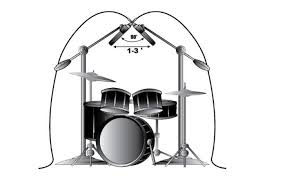
The XY or Coincident Pair is mono-compatible because the two capsules of the microphones are close together. Because they are so close together, sound waves from every drum and cymbal impinge upon the two microphones diaphragms nearly simultaneously, avoiding any risk of comb filtering due to partial cancellation of out-of-phase waves when the two overhead tracks are heard in mono. The only problem with this technique is that the width of the stereo field is very narrow when the overhead tracks are hard-panned left and right. Of course, this would be a great choice when the stereo width of the drums is not important or when the drums is playing as a supporting role. The height of the overhead is also important. When the overhead goes higher, the capsules will eventually point straight over the sides of the kit which would essentially put the entire kit off-axis. This will result in an overly roomy sound since the microphones would capture more of the room tone than the drum kit itself.
Mid-Side

The Mid-Side technique is a stereo technique that ensures mono compatibility like the XY technique. It employs a “mid” Cardioid microphone pointed at the source and a “side” microphone with a figure-8 polar pattern whose null is pointed at the source. The “side” channel will be split into two channels, hard-panned left and right with one of the channels being phase inverted. One of the benefits of this technique is that the width of the stereo image can be adjusted by adjusting the levels of the “side” channels. The louder the “side” channel is, the wider the stereo image is. The downside of this technique is that the “side” microphone will only capture the reflected sound in the room so when recording drums in a small or untreated room, chances are the reflected sound would not sound good and the recording done will sound muddy.
Recorderman

The next technique is the Recorderman technique. It is still considered as a fairly new technique and is the least known technique compare to the others. It is conceptually similar to the Glyn Johns’ technique with the same overhead configuration. It requires two Cardioid microphones with one suspended about 81 cm above the center of the snare drum, pointing straight down. The other is positioned near the drummer’s right shoulder, pointing directly at the snare drum from 81 cm away. However, the distance of the microphones from the snare is not necessarily required to be exactly 81 cm away but they do require to be the exact same distance from one another. According to Davida Rochman, this technique requires that the kick drum is also equidistant from both microphones. This is because the kick drum may be out of phase if they are not at equal distance from both microphones to the kick. The two tracks are panned left and right, although it is not necessarily to be a hundred percent because extreme panning of the Recorderman overhead tracks can leave a hole in the middle of the stereo field. Unlike the Mid-Side and XY technique, this technique is not really mono-compatible, except for the kick and snare. This technique is more suitable for small, untreated rooms or drummers who bash their cymbals way too loud because the microphones pick up primarily the drums but cymbals will be understated as well as the sound of the room. Of course, it does not mean that this technique will sound badly in a large, acoustically treated studio. Having a more-distant ambient microphone would result in a roomier sound.
ORTF

Moving on, the ORTF technique is one of the easiest technique to set up beside the XY technique, using a stereo bar so that two microphones can be placed on to one stand instead of two. This technique uses two cardioid microphones with a spacing of 17 cm between the microphone diaphragms and with 110° angle between the capsules. According to Tom Bates, the intention of this technique is to reproduce stereo cues that are similar to those that are used by the human ear to perceive directional information in the horizontal plane. The spacing of the microphones emulates the distance between the human ears, and the angle between the two directional microphones emulates the shadow effect of the human head. The stereo image of this technique is wider than XY, Mid-Side, and Recorderman since it simulates the human ear position, in which resulting in a very natural and realistic stereo field. It is also mono-compatible, without any significant problems. Because the microphones are widely spread, it is likely that the drums will be off-axis since the microphones would be pointing at the sides of the kit. Also because of this, using this technique in a small, untreated room would be a bad choice because the microphones will mostly hear reflected sounds. This can be solved by moving the microphones closer to the drum kit, which would result in a drier sound.
AB/Spaced Pair

Finally, the AB of Spaced Pair technique is known to be one of the simplest stereo technique to understand but it presents the most problems in practice. Because the microphones are far apart from each other, this technique is at risk to comb filtering or easily having an out of phase snare if it is not set up carefully. To avoid these problems, Matthew Mcglynn stated that the easiest way to avoid screwing up the snare sound with phasing problems is to put the two capsules of the spaced pair at equal distances from the center of the snare head. This has the added benefit of centering the snare in the stereo image, which is most likely where you want it anyway. Besides that, the AB technique is a powerful technique, which provides a large palette of sonic colors. The amount of room sound can be controlled by adjusting the height of the microphones, changing the polar pattern from a Cardioid to a wider one, or angling them towards the center of the kit to minimize the amount of room sound. Moving the pair further out toward the sides of the kit would give a wider stereo field and makes the sound roomier.
Final Thoughts
It really comes down to your own vision when you think about how you wanted the drums to sound in the mix and that these techniques are almost subjective towards your own production style. But there is nothing wrong with doing a little experiment. Instead of following these techniques, you could try out something different while using the guidelines of these techniques as reference. Go wild with your recording! Just keep in mind and make sure that both microphones are in phase with one another because you will gonna go through hell trying to fix some problems that can be pretty obvious if you are not careful.
Have fun recording!
Source:
Rochman, D 2011, Five Types for Stereo Miking Drums, Shure blog
Mcglynn, M 2010, Drum overhead microphone technique comparison, Recording Hacks http://recordinghacks.com/2010/04/03/drum-overhead-microphone-technique-comparison/


Comments